18 Best Apple HomeKit Devices and Accessories (UK, 2026)
HomeKit is Apple’s smart home ecosystem that centres around the Home app and Siri as a voice assistant. If you’re an iPhone and Mac user, chances are that this will be your go-to smart home platform.
Due to Apple’s strict requirements for HomeKit devices, there aren’t as many compatible devices as Google and Amazon’s ecosystems, but once you dig deep, there are some great products to choose from. Luckily, I’ve done all the digging deep for you and shared everything in this guide.
Here are my recommended smart home devices for HomeKit:
HomeKit Hub
HomeKit works slightly differently from other smart home ecosystems. Whilst you can use your iPhone to control devices when you’re at home, their framework requires you to set up a hub which is always powered on and issues commands to your other HomeKit devices when you’re away.
Devices that can act as a hub include:
- Apple TV
- HomePod
- HomePod Mini
- Apple HomeView
The iPad used to be on this list, but Apple no longer lists it as a home hub.
Your hub is what lets you control your accessories when you’re out, share access with the rest of your household and run automations. You also need one to add Matter accessories to the Home app, and Thread accessories need a hub that supports Thread.
Your designated hub will also handle HomeKit Secure Video. Footage from your cameras is processed on your hub (or in Apple’s Private Cloud Compute) before it’s encrypted and stored in your iCloud account, which makes it very secure.

Apple TV 4K (4th generation)
A TV box that doubles as a HomeKit hub, with Thread and Gigabit Ethernet built in.
View on AmazonMy recommendation for a hub is the Apple TV 4K. As well as running your automations and giving you remote access, it has Thread built in, so it can act as the hub for the Thread accessories on this list, including the smart button and the door and motion sensors.
It also has a Gigabit Ethernet port, so you can plug it straight into your router rather than relying on Wi-Fi. And because it plugs into your TV, you get a streaming box at the same time (more on that below).
If you’d rather have a speaker as your hub, the HomePod Mini also works as a home hub and supports Thread.
Smart Light Bulbs
Now, your smart home is going to need some smart lighting which can be done through smart bulbs or smart switches.
I prefer using smart bulbs as they are the cheapest and easiest option, although they render your existing light switches useless. Alternatively, smart switches give you access to both physical switches and smart features, but you won’t have access to coloured bulbs.
Look for bulbs that support Apple’s HomeKit Adaptive Lighting which launched in iOS 14. This adjusts the lights in your home throughout the day, starting with warm colours in the morning, then bright energetic during the day, and finally removing the blue in the evening to help you wind down.
Philips Hue White and Colour Ambiance
One of the only brands to support HomeKit Adaptive Lighting with colour bulbs for any fitting.
View on AmazonPhilips Hue is one of the only brands to support HomeKit Adaptive Lighting so I’d recommend you stick with their products.
I recommend you start with their white and colour ambiance bulbs, these are available with almost any fitting including Bayonet-style, Edison Screw, and most spotlights.
The only downside is that Hue bulbs use Zigbee and require a dedicated Hue Bridge which adds extra costs to get started.
Philips Hue Bridge
The dedicated hub that Hue bulbs require, and how they connect to HomeKit.
View on AmazonSmart Light Switch
If you’d rather keep your existing bulbs, or you don’t want anyone turning off your smart bulbs at the wall, a smart light switch is the alternative I mentioned above.
A smart switch takes the place of (or sits behind) your normal wall switch, so anyone can still turn the lights on and off as usual, while you get Siri control, schedules and automations in HomeKit.
Lightwave Smart Dimmer (2 Gang)
A UK smart dimmer switch that works with HomeKit and replaces your existing switch with no extra wiring.
View on AmazonFor UK homes, I recommend Lightwave. Its Smart Dimmers are designed to replace standard UK light switches with no additional wiring required, and they work with HomeKit, so your lights appear in the Home app alongside everything else.
The one I’ve linked is a 2 gang switch, and there’s also a 4 gang version. It monitors energy use too, and Lightwave offers a free setup call with its UK-based support team if you get stuck with the installation.
You’ll need the Lightwave Link Plus hub, which connects to your router and can control hundreds of Lightwave devices, so you can start with one switch and expand from there. Your Apple home hub is still what lets you control them when you’re out.
Lightwave Link Plus Hub
The Lightwave hub you need for app and voice control of Lightwave switches.
View on AmazonIf you’d rather keep your existing switches, the Meross Matter Smart Light Switch is a tiny module that fits behind most standard 1-way, 1-gang wall switches and adds HomeKit control through Matter. Keep in mind that it needs a neutral wire, so check your wiring first or ask an electrician.
Meross Matter Smart Light Switch Module
A tiny Matter relay that fits behind your existing wall switch to add HomeKit control. Neutral wire required.
View on AmazonSmart Button
A smart button is the kind of device that you don’t realise you need until you have one. You can use a smart button to trigger scenes in HomeKit.
For example, you could use them as light switches so that you still have a physical switch, or you could use them to open/close your smart blinds.
Onvis HS2 Thread Smart Button
A five-key HomeKit button with single, double, and long-press options for up to 15 scenes or accessories.
View on AmazonThe Onvis Smart Button is designed for HomeKit and connects directly to your HomeKit hub, with no bridge or cloud in between. It uses Thread, so you’ll need a hub that supports Thread, such as the Apple TV 4K or HomePod Mini.
It has five buttons, and each one has three ways to press it: single press, double press, or long-press. That means one small remote can trigger up to 15 different scenes or accessories, so one remote by the sofa could handle the lights, a film scene and your goodnight scene.
It also comes with a magnetic mounting plate that you can stick on or screw to the wall, so it can sit by the door like a normal light switch and still lift off when you want to use it as a remote. The dots on the buttons glow in the dark, so you can find the right one at night.
Smart Thermostat
Adding a smart thermostat to your home allows you to set more advanced heating schedules than a traditional thermostat and lets you control it using Siri.
Convenience isn’t the only selling point, they also make your home more efficient. Depending upon the device, you can use the native app or the Apple Home app to adjust your devices based on who is home.
tado° Wireless Smart Thermostat X (2nd gen)
A rechargeable smart thermostat that works with Apple Home through Matter, with heating and hot water control.
View on AmazonI still recommend tado for a HomeKit home. The latest Smart Thermostat X works with Apple Home through Matter, so you can control it from the Home app alongside your other accessories, or ask Siri on a HomePod to change the temperature.
The starter kit includes a programmer that connects to your boiler or heat pump, and it can also control your hot water schedule if you have a cylinder. Keep in mind that hot water control stays in the tado app, as it isn’t supported in Apple Home yet.
The thermostat itself has a rechargeable battery that tado says lasts over a year on a charge, and it charges over USB-C, so there are no batteries to swap. The display shows the temperature and humidity, and you just swipe the light ring to turn the heating up or down.
You can also add smart TRVs to each radiator and create zones in your home, which means you can have different temperatures in each room. Extras such as geofencing and open window detection are now part of tado’s optional AI Assist subscription.
Smart TV Box
Whether you have a dumb TV or a smart TV, chances are that it doesn’t natively support HomeKit. However, you don’t need to go out and buy a new TV set as you can add support with a TV box.
This will plug into the HDMI input on the back of your TV to access streaming services and other smart features such as controlling your HomeKit devices.
Apple TV 4K (4th generation)
Streams in 4K with Dolby Vision and Dolby Atmos, and doubles as your HomeKit hub.
View on AmazonMy pick here is the same Apple TV 4K that I recommended as a hub above, so one box covers both jobs.
The Apple TV box plugs straight into a HDMI port to make your TV smart, giving you access to a range of streaming services. It also supports AirPlay for streaming photos and video from your iPhone or Mac.
The latest model supports 4K with Dolby Vision, HDR10+ and Dolby Atmos. It also has microphones built in, so you can talk to Siri from across the room instead of reaching for the remote.
Keep in mind that you can’t yet watch Freeview on an Apple TV, but you’ll be able to install broadcaster apps such as BBC iPlayer to watch live TV channels.
On the TV itself, you can see and control your HomeKit accessories from Control Centre. And if you have four HomePod (2nd generation) or HomePod Mini 2 speakers in matching pairs, you can use them with the Apple TV for home cinema surround sound.
Smart Home Controller
Being able to control your smart home using your voice is awesome, but it’s not always the most convenient. Especially if you have guests around that don’t know the commands, or you don’t want to make noise at night.
That’s why a wall-mounted control panel is a great HomeKit accessory. This will also give you a convenient place to access your live camera feeds without having to get your phone out.
Apple iPad 11-inch (A16)
An iPad on the wall makes a simple, always-on control panel for the Home app.
View on Amazon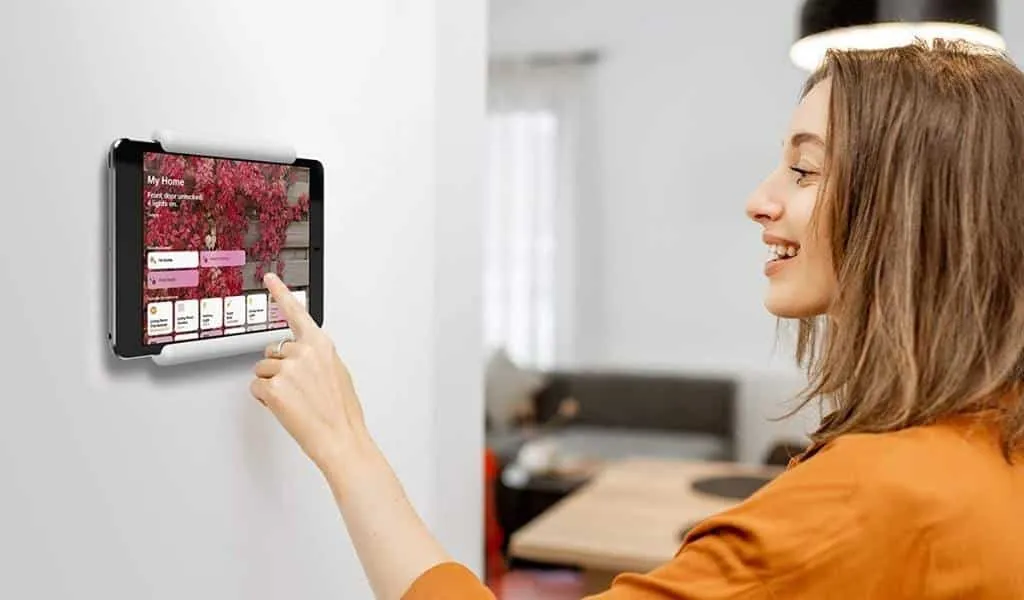
Apple’s Home app already has an excellent interface to act as a smart home controller so I recommend using an iPad as your controller. The standard 11-inch iPad has plenty of screen for the Home app. Simply pair it with a wall-mount and leave the screen on all the time and you’re good to go. It’s best to create a separate Apple Account for this iPad so that it’s not interrupted with notifications.
I would recommend opting for a wall mount that still allows you to remove the iPad, such as the Elago Home Hub Mount. It holds the iPad between two pieces of scratch-free silicone, so you can lift it out whenever you need it, and the screws and wall plugs are included. If you’re up for a bit of DIY, you can run a USB cable through the wall to the iPad, or for an easy life, you can install it near a power socket.
Elago Home Hub Mount
A wall mount that holds your iPad in scratch-free silicone, so you can lift it out any time.
View on AmazonIf you want a bit more customisation, the premium Home+ app is similar to the Home app but with more options for creating a personal dashboard.
Apple now also makes its own wall-mounted smart home display, Apple HomeView, which is available from Apple. It has the Home app built in, can show up to nine camera feeds at once and works as a home hub, but an iPad on the wall is still a great option.
Smart Curtains/Blinds
When it comes to the cool factor, there’s just something awesome about your blinds or curtains opening by themselves in the morning. This is no longer the work of sci-fi, Siri can now handle that for you.
Using smart curtains, you can create a morning scene in HomeKit to open all the curtains in your home. You could even create an automation for when you’re on holiday so it looks like someone is home.
SwitchBot Curtain 3
A retrofit curtain opener that fits your existing curtain rod with no drilling or tools.
View on AmazonMy favourite device for making your curtains smart is still from SwitchBot. The Curtain 3 fits onto your existing curtain rod with no drilling, no tools and no permanent changes, so you can install it in minutes.
It can move heavy curtains up to 15kg, and Silent Mode keeps it below 25dB, so it’s quiet enough to open the bedroom curtains in the morning. There are versions for curtain rods and U rails, and you’ll need one unit per curtain, so centre-opening curtains need two.
To use it with HomeKit, you’ll need a SwitchBot hub such as the Hub 2, Hub 3 or Hub Mini (Matter Enabled). Once it’s connected, your curtains appear in the Home app and you can open or close them with Siri.
If you’ve got horizontal blinds with a tilt rod, the SwitchBot Blind Tilt works with your existing blinds and tilts the slats open and closed for you. It has a built-in solar panel, adjusts to the nearest 2°, and works with Apple Home through the same SwitchBot hubs.
SwitchBot Blind Tilt
A solar-powered motor that tilts the slats on your existing horizontal blinds.
View on AmazonGarage Door Opener
If you’ve got a motorised garage door, it’s simple to give Siri access with a smart garage door controller. These devices can be retrofitted to existing garage door systems so that you can simply say “Hey Siri, open my garage” for access.
It doesn’t stop there, once you’ve added your garage door to HomeKit, you can create some epic scenes. For example, when you arrive home, your outdoor lights can turn on, your garage door can open, and the smart kettle can boil ready for a brew once inside, ideal!
Remootio 3 Smart Garage Door Opener
Retrofit controller that brings most existing garage door openers into Apple Home, with Bluetooth backup.
View on AmazonMy pick for HomeKit is the Remootio 3. It retrofits to most existing garage door openers, and Remootio has a compatibility checker on its website so you can check your model before you buy.
Once it’s set up, your garage door appears in the Apple Home app, so you can open it with Siri, or from CarPlay as you pull onto the drive.
It also connects over Bluetooth, so you can still open the door from your phone if your Wi-Fi or broadband goes down. You can share access with a QR code or link, with time limits if you like, so family or tradespeople can get in without needing the app.
Keep in mind that HomeKit only works if you set the Remootio up as a garage door opener rather than a gate.
Video Doorbell
With a video doorbell, you can see and speak to whoever is at your front door from anywhere in the world. You’ll receive a notification to the app on your phone when it detects motion so you can check in on the live feed, it will also ring you when someone presses the button.
By choosing a HomeKit compatible doorbell, you’ll also be able to see the live feed from the Apple Home app along with any other security cameras and you can ask Siri to bring up a feed on your Apple TV.
Aqara Doorbell Camera G400
A weatherproof 2K wired doorbell with HomeKit Secure Video and a head-to-toe view.
View on AmazonFor a video doorbell that works with HomeKit, I recommend the Aqara G400, which is also my top pick in my guide to the best HomeKit video doorbells.
It supports HomeKit Secure Video, so your recordings are encrypted and stored in iCloud using your iCloud+ plan. You’ll also need a home hub, such as the Apple TV above.
Its 2K camera has a tall, head-to-toe view, so you can see parcels left on the doorstep as well as the face of whoever’s at the door. It’s IP65 rated, so it’s built to cope with wind and rain, and a plug-in chime is included.
It’s wired only, so you’ll need PoE or existing doorbell wiring. Keep in mind that HomeKit limits the video to 1200p.
Smart Lock
Once you’ve seen who is at the door, you might want to unlock it remotely. This is just one of the many features you’ll get from a smart lock.
When you add a smart lock to HomeKit, it will appear as a tile in the Home app where you can easily lock or unlock it. You’ll also be able to unlock it with your voice via Siri or using an Apple Watch.
One of the best ways to use a smart lock with HomeKit is via a Goodnight scene that will lock your doors, arm your alarms, and turn off all the lights and plugs in your house.
Ultion Nuki Smart Lock 2025
A UK smart lock with a 3 Star Plus cylinder, built-in Wi-Fi and Apple Home support through Matter.
View on AmazonFor a UK home, I recommend the Ultion Nuki Smart Lock 2025, which is designed and sold specifically for UK doors.
It pairs Nuki’s smart lock with Ultion’s 3 Star Plus cylinder, which is anti-pick, anti-bump and anti-drill and meets the Police Preferred specification.
It replaces your existing cylinder rather than fitting over it, but on a standard British cylinder lock that only takes a few minutes and doesn’t need any new holes. You can still use a physical key from outside.
It works with Apple Home through Matter, and Wi-Fi is built in, so there’s no extra bridge to buy. In the Nuki app, you can also set it to unlock automatically as you arrive home and send time-limited access to guests.
The one I’ve linked is for PVC and composite doors under 55mm thick, so measure your door first.
Smart Door Sensors
If you want to create some great automations in HomeKit, I recommend you get hold of some door or window sensors.
You can use this for clever things such as lighting up a cupboard when you open the door, alerting you when a toddler is trying to escape their room or to remind you if you’re leaving the house with windows or doors left open.
Eve Door & Window (Matter) 3-Pack
Thread contact sensors that connect to your home hub without a bridge, with no account or cloud.
View on AmazonThe best HomeKit door and window sensor is still from Eve because it can be connected directly to your HomeKit hub without the need for an additional bridge or Wi-Fi connection. The current version uses Thread and Matter, so you’ll need a hub that supports Thread, such as the Apple TV 4K or HomePod Mini.
Once added to the Home app, you can quickly see if the door or window is open or closed, and use it in automations. For example, your hallway lights can turn on when you come in after sunset, or your heating can pause when you open a window. You can choose to be notified every time it opens, or only when no one is home.
There’s no Eve account to sign up for and no Eve cloud to worry about. It runs off a single ½ AA battery (ER14250), which is replaceable.
Smart Motion Sensor
Motion sensors are one of the most useful triggers for HomeKit automations. When someone walks into a room, the sensor can turn the lights on, and when the room is empty for a while, it can turn them off again.
They’re handy for security too, as you can get a notification if there’s movement while you’re out.
Eve Motion (Matter)
A Thread motion sensor with a built-in light sensor, for indoors or outdoors, with no bridge needed.
View on AmazonLike the door sensor above, I recommend Eve Motion because it connects straight to your home hub using Thread, without an extra bridge. You’ll need a hub that supports Thread, such as the Apple TV 4K or HomePod Mini.
It covers a 120° field of view up to 9 metres away, and it runs on batteries, so you don’t need a power socket nearby. It’s IPX3 rated, so you can even use it outdoors.
Its built-in light sensor makes your automations smarter, as your lights only come on when there isn’t enough daylight. You can also choose to be notified about motion any time, or only when no one is home, and like the door sensor, there’s no Eve account or cloud.
Smart Plugs
A smart plug is a great way to retrofit an existing device in your home so that you can add Siri control without having to go out and buy a brand-new state-of-the-art device.
Simply plug it into the wall socket and then plug your device into it for smart control. This tends to only suit devices that are always on or always off. Some example uses might be a lamp, fan, radio, Christmas lights, games console, etc.
Meross Matter Smart Plug Mini (2-Pack)
A compact 13A smart plug that works with Apple Home through Matter, with energy monitoring in the Meross app.
View on AmazonMeross is still my pick for a budget-friendly HomeKit smart plug. The Smart Plug Mini uses Matter, so you just scan the code to add it to the Home app, and the same plug also works with Alexa and Google Home if anyone else in your house uses them.
It’s a 13A plug, and the compact design means it shouldn’t block the socket next to it. There’s also a power button on the side if you want to switch it on or off by hand.
It monitors energy use too, although you’ll need the Meross app to see that, as it doesn’t show in the Home app. Keep in mind that it needs a 2.4GHz Wi-Fi network.
Security Camera
I’ve already mentioned a video doorbell as an excellent security device, but you can also opt for smart security cameras instead.
Add your smart security cameras to HomeKit and you’ll be able to pull up live feeds from within the Home app. I recommend looking for cameras that support HomeKit Secure Video, this means the video is processed on your home network by your HomeKit hub before being encrypted and stored in your iCloud account.
With Secure Video, you can also use motion from your camera as a trigger in automations. For example, when the camera detects motion, it can turn on a nearby floodlight.
Aqara Camera G100
An IP65 2K camera for indoors or outdoors with full HomeKit Secure Video support.
View on AmazonMy pick is now the Aqara G100. It fully supports HomeKit Secure Video, so your footage is stored in your iCloud account using your iCloud+ plan. Aqara’s own HomeGuardian subscription is optional and only adds extra cloud features, such as pet and package recognition.
It’s IP65 rated, so you can use it indoors to keep an eye on pets or mount it outside to watch the front door or driveway. It records in 2K with a choice of colour night vision using its built-in spotlight or discreet infrared, although HomeKit limits the video to 1080p.
It also detects people on the camera itself, so it can notify you only when it sees a person rather than every time something moves.
Unlike the Eufycam I used to recommend, it isn’t battery-powered. It needs mains power through a USB-C cable, and the plug isn’t included, so mount it within reach of a socket or run a longer cable.
Smart Smoke Alarm
Smoke alarms are an essential gadget that every home needs. But why not give them a smart upgrade and bring them into your HomeKit ecosystem.
The benefit of this is that you can get an alert whenever your smoke alarm goes off, no matter where you are in the world. You can then use your other HomeKit devices to check what’s going on or contact a neighbour if in doubt.
Netatmo Smart Smoke Alarm
10-year battery life with self-testing for batteries, smoke detector, and Wi-Fi connection.
View on AmazonThe Netatmo Smart Smoke Alarm is still my pick because it works with HomeKit without needing a Netatmo hub or bridge. It connects to your Wi-Fi router, and you add it to the Home app with the HomeKit setup code that comes with it.
With a home hub, you’ll get alerts wherever you are, and you can even hush the alarm from your phone when you’re out of Bluetooth range. Just make sure there’s no fire before you do.
The device will last 10 years in typical use without needing to change the battery, this is great news if you’ve ever been woken up by a smoke detector low on battery. When you do get a low battery alert, it’s time to replace the alarm.
It is self-testing so it regularly checks its own battery, smoke sensor, and Wi-Fi connection and will alert you if there is any problem. That’s what I like to see.
Smart Carbon Monoxide Alarm
If you have fuel-burning appliances such as a boiler or a fireplace, a carbon monoxide alarm is a must. Carbon monoxide is odourless and invisible, so you won’t know it’s there without one.
A smart carbon monoxide alarm will also alert your phone wherever you are, so you’ll know about it even if no one is home.
Netatmo Smart Carbon Monoxide Alarm
A standalone CO alarm with an 85dB siren, phone alerts, self-testing and a 10-year battery.
View on AmazonNetatmo’s Smart Carbon Monoxide Alarm is the partner to the smoke alarm above, and it works with HomeKit in the same way. It’s standalone, so you don’t need to buy a Netatmo hub.
In the Home app, you can see its status at a glance, and you can use it in automations, for example turning on all the lights in the house if carbon monoxide is detected.
Like the smoke alarm, the battery lasts 10 years in typical use, it tests itself and alerts you if anything is wrong, and there’s no wiring to install. If you need both, Netatmo sells the two alarms together as a bundle.
Netatmo Smart Smoke Alarm + Smart Carbon Monoxide Alarm
Both Netatmo alarms in one bundle, each with phone alerts and HomeKit support.
View on AmazonSmart Outdoor Lights
Now that the inside of your home has had a Siri upgrade, now I want to share some smart devices for the garden, starting with some lighting.
Whether you want to provide safety along your pathway, light up your patio for guests, or add some feature lighting to the flower beds, by using smart lights they can control themselves.
To control your outdoor lighting, I would recommend that you use the sunset option within the time automation tab, this way you won’t need to adjust the timing of the lights as the days get longer or shorter.
Philips Hue Discover Wall Light
Bright outdoor wall lights perfect for entertainment areas, using Zigbee mesh network for extended range.
View on AmazonI already mentioned that Philips Hue was one of the better options for indoor lights, well they are also great for outdoor lights, not least because they have such a huge range to choose from.
My favourite are these Hue Discover wall lights, they are simple but also very bright so you can easily use them in outdoor entertainment areas so that your BBQ can go on all night long.
But, if you’re looking to add some ambiance to your garden, there are also Hue Lily Spotlights and a Hue Outdoor Light Strip. The best part about Hue is that they use Zigbee, a mesh network. This means each light only needs to be within range of one other light rather than the router as is the case with Wi-Fi outdoor lights.
Philips Hue Lily Outdoor Spotlight
An IP65 outdoor spotlight with white and colour ambiance light.
View on Amazon Philips Hue Outdoor Lightstrip (2m)
A 2m outdoor light strip with white and colour ambiance light.
View on Amazon